How KARL LAGERFELD Migrated from Salesforce to Shopify and Built Far More Granular Merchandising
As part of a strategic move to increase agility and business autonomy, KARL LAGERFELD migrated from Salesforce Commerce Cloud to Shopify.
During the move they wanted to get ahead of a common hurdle that enterprise retailers often face when migrating: Having to manually rebuild their entire product logic.
Instead, KARL LAGERFELD looked for a solution that would keep their complex merchandising rules intact when moving to Shopify, without heavy implementation or relying on developers.
There was only one logical option: Kimonix.
~100
Category & Listing Pages Live at Launch
0
Developer Dependencies Post-Launch
The Migration Partner
Domaine Europe
Purpose-built for ambitious & beloved brands
As the migration partner for KARL LAGERFELD, Domaine Europe delivered an enterprise-grade transition from Salesforce Commerce Cloud to Shopify with a strong focus on preserving business-critical functionality. By working closely with Kimonix, a clean separation between platform and merchandising was architected. Domaine Europe delivered the Shopify commerce foundation, while Kimonix handled advanced merchandising logic, thus eliminating the need for custom code or middleware. The result? A successful launch that ensured merchandising is a business lever: lower costs, faster change cycles, and full flexibility across markets without ongoing developer dependency.

“For enterprise migrations like this, success depends on the ecosystem. Because we've partnered with Kimonix for years with consistently strong results, we were confident in their ability to support KARL LAGERFELD's merchandising complexity. What stood out was their smart, elegant architecture, keeping stores high-performing without adding unnecessary complexity. It's exactly the kind of partnership we value at Domaine.”
Bob Rockland
Founder, Code (acquired by Domaine)
About KARL LAGERFELD
KARL LAGERFELD is a global fashion brand known for modern, bold design inspired by the creative vision of designer Karl Lagerfeld. The brand offers ready-to-wear fashion, accessories, and lifestyle products for men, women and children.
Because KARL LAGERFELD manages a large, fashion-driven catalog across multiple markets, product order and category structure are critical to how the brand is presented online. This need for faster, more flexible category and merchandising control was a key reason for moving from Salesforce to Shopify.
But before moving, they had a big merchandising challenge to cross.
The Salesforce-to-Shopify Merchandising Challenge
On Salesforce, KARL LAGERFELD had relied on complex product sorting and category rules that required heavy technical setup to manage. Every adjustment meant pulling in IT or external developers.
When moving to Shopify, those same merchandising rules did not exist by default and risked being lost entirely. The challenge was:
- Shopify's native Smart Collections couldn't support their complex merchandising data hierarchy
- Their previous setup had merchandising logic stuck in middleware
- Product ranking had to work both globally and per local market
- Frontend merchandising tools risked slowing down site performance
- Strong visual control was required for hero products and fashion sets
- Preserving product order and visual presentation without creating new developer dependency
The Solution
With Kimonix, KARL LAGERFELD was able to handle complex product sorting and category logic directly inside Shopify, without custom code, middleware, or frontend tools.
See how Kimonix builds Shopify collections →
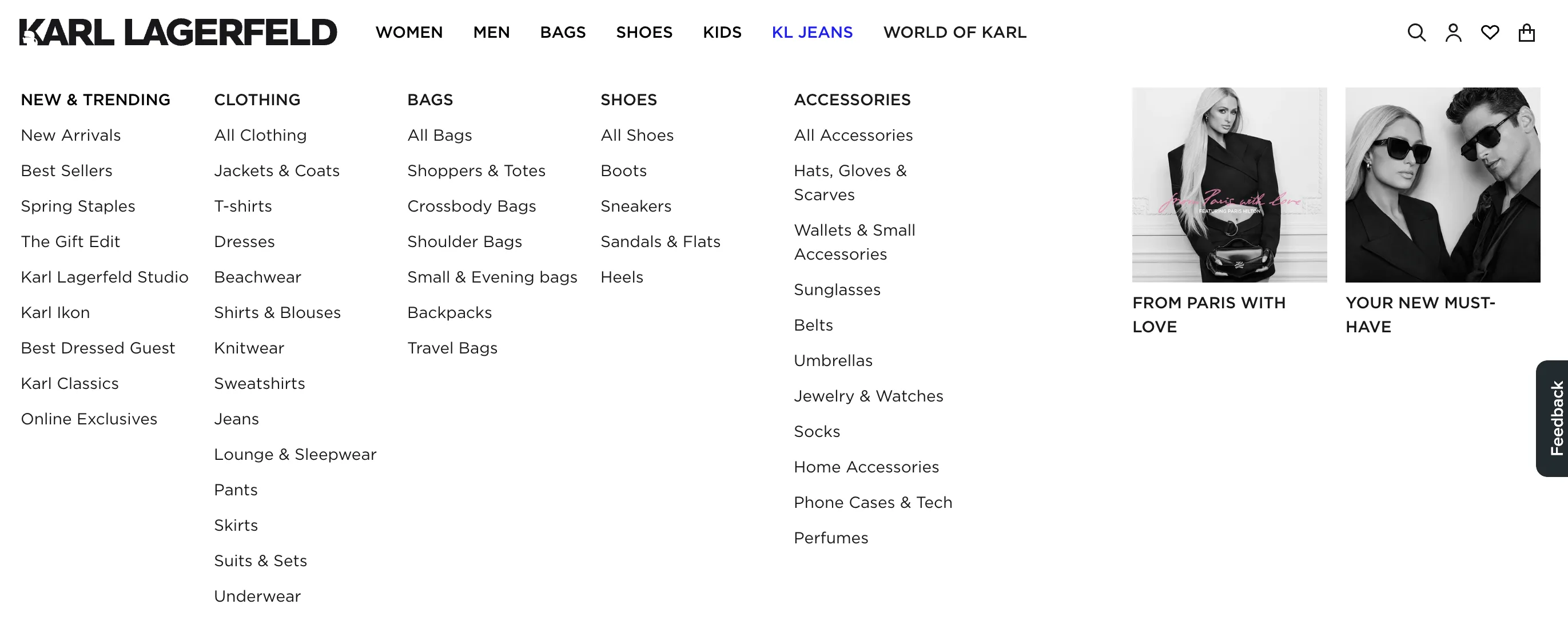
KARL LAGERFELD's Shopify launch went live with ~100 category and listing pages already configured in Kimonix, no manual fixes, no developer support required.
How Kimonix's Automated Merchandising Platform Supported the Migration
As soon as the product catalog was imported into Shopify, KARL LAGERFELD's team started building collections in Kimonix. They had previously managed categorization business logic in middleware and desperately wanted to move away from that setup.
Their team rebuilt all categories and product-ordering rules in Kimonix, from scratch. The process proved to be smoother and quicker than expected.
This allowed the Shopify site to launch with correct product order and around 100 category pages live from day one, without manual fixes or developer support.
Salesforce Commerce Cloud to Shopify: the merchandising parity guide →
Advanced Backend Merchandising Logic for Shopify Migration
Kimonix provides advanced backend merchandising logic that automatically controls how products are ordered and shown in Shopify collections. It uses real-time performance, stock, and customer behavior data to keep product ranking up to date without manual work or custom code. This logic runs fully in the backend, so merchandising can scale without affecting site speed or visual design.
- Collection Sorting
- Dynamic Merchandising Rules
- Marketization (market-specific rankings)
- Product Pinning (hero products)
- A/B Testing for Collections
- Listing Page Analytics (CTR, engagement)
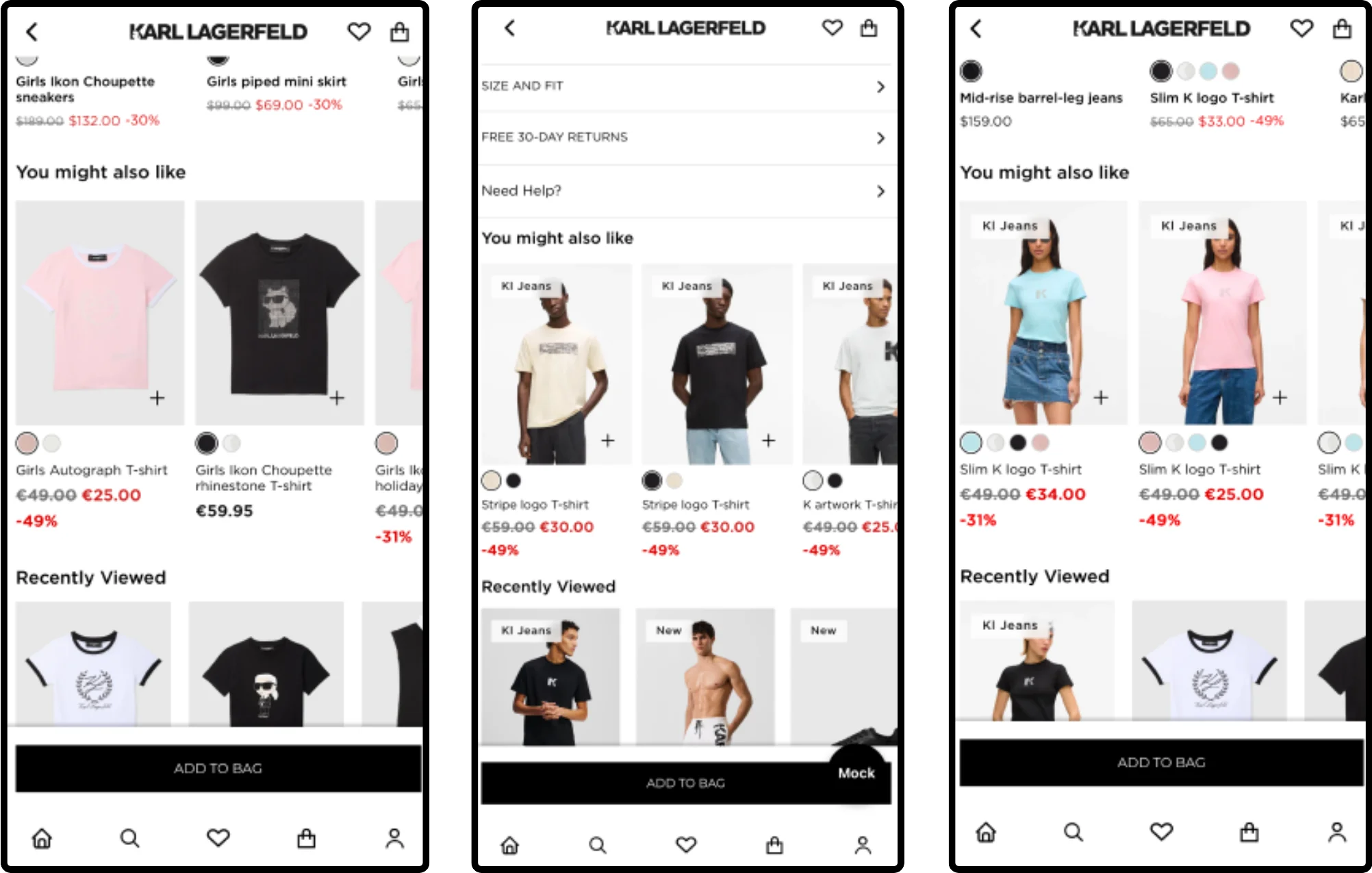
Product Recommendations in the Tapcart Mobile App
The migration was not only a web project. When KARL LAGERFELD moved from Salesforce to Shopify, they also chose Tapcart to power their mobile app, the mobile commerce platform behind Shopify apps that have processed more than $10 billion in sales. That choice unlocked something bigger: the Kimonix and Tapcart integration, which lets the same merchandising platform that governs the store power in-app product discovery.
The integration works on two levels. Collections merchandised in Kimonix sync automatically into the app, so the mobile experience always reflects the store. And, the deeper of the two, Kimonix powers the product recommendations inside the app itself. The team defines the rules in Kimonix, combining personalization with the full range of recommendation strategies and parameters, and can deploy them in any placement the app is built around. Every app shopper sees a set personalized to them, and the team adjusts it all with no release cycle and no developer time.
Merchandising stays a business decision, and the app has the flexibility to operate in step with the store or independently as the brand differentiates the app experience. Either way it keeps pace with the store instead of drifting behind it.
See how Kimonix personalizes product recommendations →
Why KARL LAGERFELD Chose Kimonix over Other Platforms
“We've had a very positive experience using Kimonix. It's easy to set up, integrates smoothly with Shopify, and saves us a lot of manual work on merchandising.”
Yoko Fujimoto Sital
Senior Manager Ecommerce Trading, KARL LAGERFELD
Matched existing merchandising complexity without rebuilding from scratch
This meant that their merchandising team could carry over advanced sorting logic they already relied on, instead of simplifying or redesigning categories after the migration.
Supported global fashion direction while allowing local differences
KARL LAGERFELD could keep global hero products consistent, while still letting rankings adapt to how shoppers behave in different markets.
Fits a premium fashion setup without forcing frontend compromises
Because merchandising logic stayed in the backend, they could avoid performance issues and allow the site's visual presentation to stay clean and on-brand.
Provided design flexibility for a premium brand
The Kimonix team customized the merchandising module design to align with KARL LAGERFELD's premium visual identity.
The Results
Thanks to using Kimonix as part of their Salesforce to Shopify migration, they had ~100 category and listing pages live at launch and gained full visibility into listing page performance (CTR metrics).
After launch, KARL LAGERFELD's business team could continuously manage merchandising themselves across markets with consistent results and no performance issues. They can now:
- Adjust merchandising without IT or developer support
- A/B test sorting strategies to optimize results
- Group coordinated items (suits, sets) to automatically merchandise together
- Offer different assortments with market-specific rankings in different markets (Germany vs. UK, for example)
- Handle collection logic without being dependent on middleware
- Run Kimonix product recommendations inside their Tapcart mobile app, personalized to each shopper
TL;DR: From Salesforce to Shopify - Without Losing Merchandising Control
This Salesforce to Shopify migration case study doesn't end there. Since the migration, Kimonix continues to manage and evolve KARL LAGERFELD's merchandising over time. They no longer need IT or developer support for every change, incredible value for a retainer with a small team.
A Shopify merchandising team that can now test, adjust, and scale product sorting across categories, collections, and markets as the business grows. All without adding technical complexity or pulling in outside resources.
This gives KARL LAGERFELD a stable, long-term setup for independently managing merchandising on Shopify.
Conclusion
★★★★★
“The data-driven recommendations are clear and actionable, helping us make better day-to-day decisions and improve overall performance.”
Yoko Fujimoto Sital
Senior Manager Ecommerce Trading, KARL LAGERFELD
Key Takeaways
100+
Category Pages Live from Day One
Thanks to using Kimonix as part of their Salesforce to Shopify migration, they had ~100 category and listing pages live at launch and gained full visibility into listing page performance (CTR metrics).
- Matched existing Salesforce merchandising complexity without rebuilding from scratch
- Supported global fashion direction while allowing local market differences
- Premium fashion setup without frontend compromises
- Business team manages merchandising independently across markets
- The Kimonix integration factored into choosing Tapcart, and now powers per-shopper product recommendations inside the app
Frequently Asked Questions
What did KARL LAGERFELD achieve migrating to Shopify with Kimonix?+
They launched with more than 100 category pages live from day one and no ongoing developer dependencies afterwards. The merchandising team could build and change category and listing pages themselves rather than queuing work with engineering.
How did KARL LAGERFELD launch 100+ category pages without developer support?+
The pages are rule-driven rather than hand-built, so membership and ordering come from live product data instead of manual curation. That let a global catalog go live at scale on a migration timeline, and it means new categories can be added later without code.
Can luxury fashion brands merchandise large catalogs on Shopify?+
Yes. The constraint on large luxury catalogs is usually team capacity, not the platform: hand-curating hundreds of category pages does not scale, and brand presentation still has to be exact. Rule-driven collections with manual pinning where it matters give both, which is how KARL LAGERFELD ran 100+ category pages from launch.
Does Kimonix power product recommendations inside a Tapcart mobile app?+
Yes. KARL LAGERFELD runs their mobile app on Tapcart, and the Kimonix integration was one of the reasons they chose it. They are the first brand running Kimonix product recommendations inside a Tapcart app: the rules are configured in Kimonix for the app itself, and each app shopper sees recommendations personalized to them, in the app's own placements.